I’m delighted to share that I’ve received the President’s Scholarship for Research in Design, awarded by Bezalel Academy of Art and Design to outstanding students in the master’s programme in industrial design. My topic is universal design, which is also called inclusive design.
The project is with Beit Noam, a day centre for people with disabilities. Beit Noam is planning a challenge park of about 16 dunams (1.6 hectares) as part of a new rehabilitation centre. The park will be planned and built by an outside firm, and my aim is to propose installations that put the principles of universal design into practice, ready for when planning begins. A company Shafan Hasela, which specialises in designing and building challenge courses, is helping me with the proposal.
Here is what the background research covered:
- Universal design, in short. It’s the idea of designing products and places so that as many people as possible can use them, without special adaptations. It differs from “accessible design”, which focuses on people with disabilities, because it considers the whole range of human abilities. The principles include equitable use, flexibility, simple and intuitive use, tolerance for error, and low physical effort. Everyone benefits: parents with strollers, people with temporary injuries, older people.
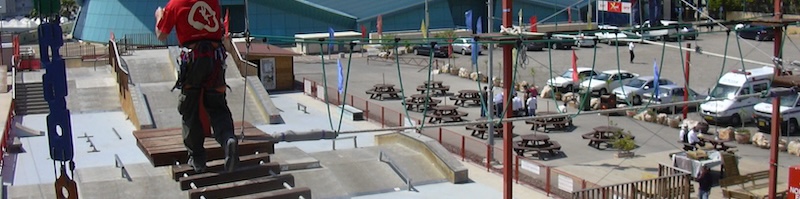
- What’s in a challenge park. I mapped the usual elements: group problem-solving games on the ground, low and high ropes courses, climbing walls, zip lines, and the equipment that keeps people safe, such as harnesses, helmets and belay devices.
- What the industry says. The industry’s own standards say that people with disabilities should have access to challenge courses, and that this should be a meaningful challenge, not a token one. In practice, though, at least in the US, fewer than half of the courses are accessible, and some of those are of doubtful value. I looked at companies that have built universal design into their courses, such as Challenge Unlimited, Ropes Courses Inc. and Alpine Towers.
- People matter as much as equipment. The team leading an activity needs to read non-verbal signals, notice fear even when it isn’t spoken, encourage risk-taking, and avoid being overprotective. One simple rule from the research: if some participants need helmets, make everyone wear one.
I also visited two places to see what this looks like on the ground. At X-park in Haifa, I joined an activity for children with cancer. The park is reachable by wheelchair from the car park, and the zip line can carry a person together with a companion, but the high ropes course and the zip line’s entrance aren’t accessible to wheelchair users. In Ra’anana, in Haverim Park, a playground built with children with disabilities in mind, I saw that equipment can be accessible and still not give a satisfying experience. That gap, between “can get in” and “can really take part”, is exactly what I want to design for.
Now for the design direction.
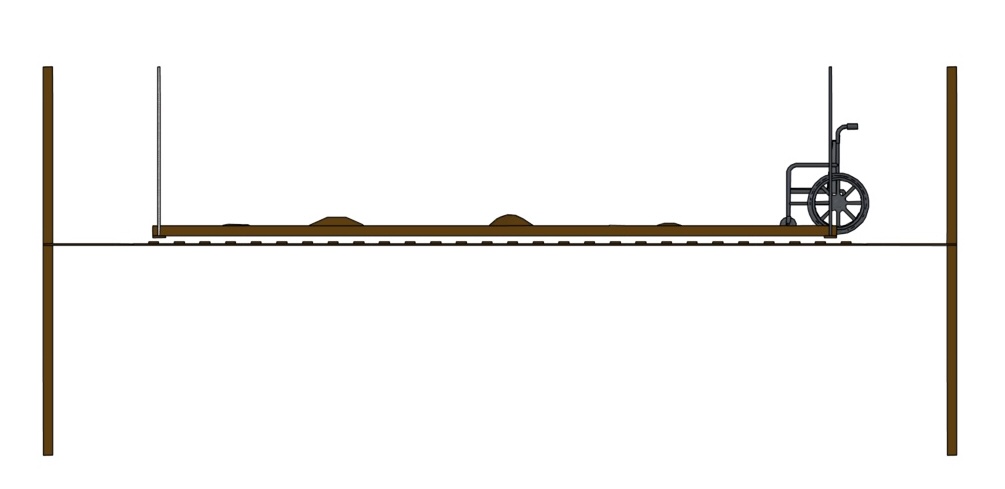
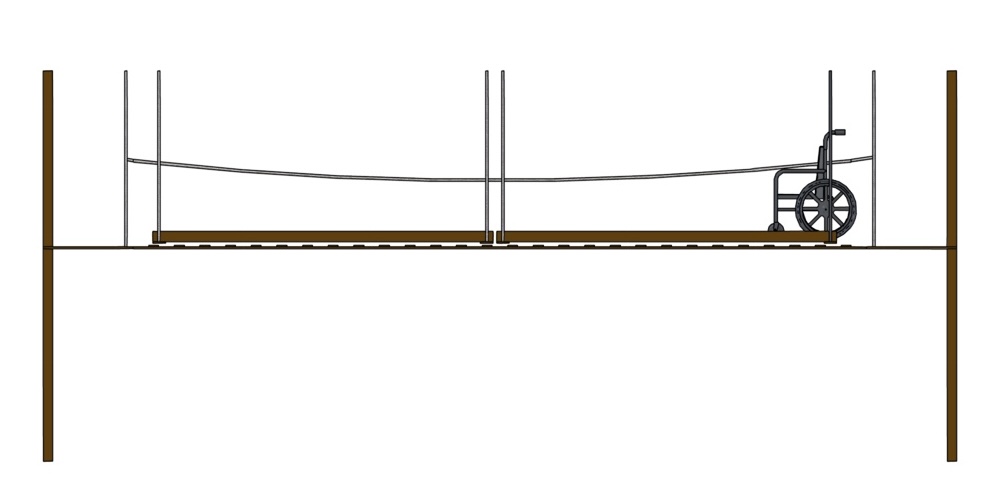
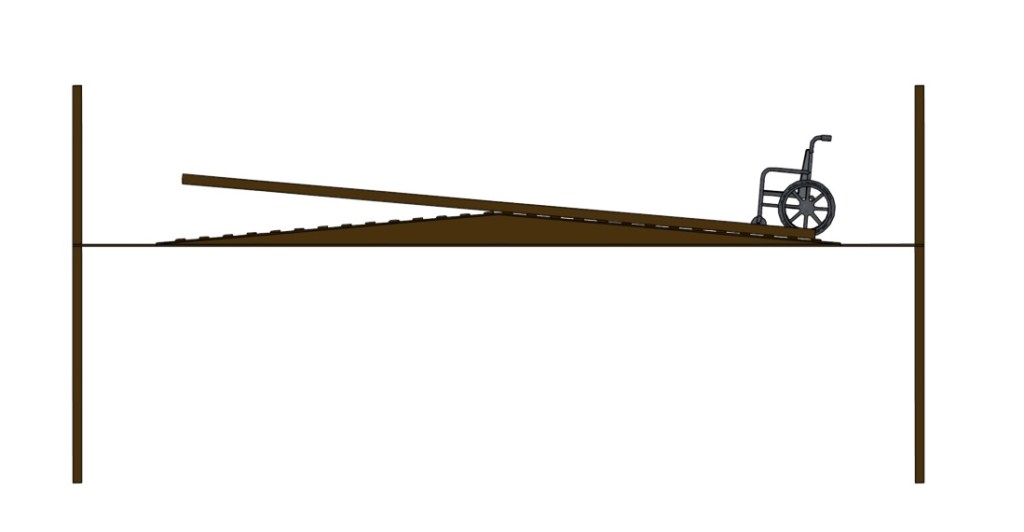
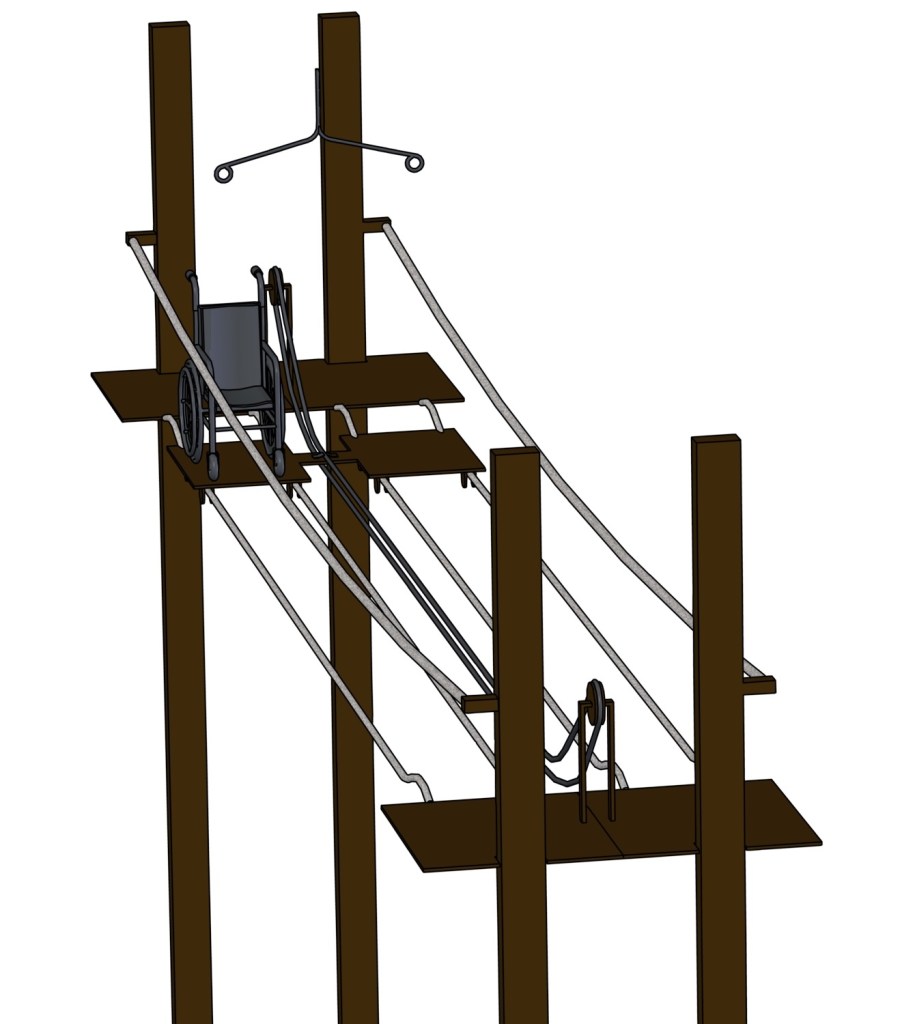
I’m developing an installation at height that people can use in their own wheelchairs. Wheelchair users stay in their own chairs, and those who walk get a chair of the installation. In both cases, the participant and the chair are clipped to a safety loop above their head.
The installation is a series of “bridges” between resting points, built on two principles. First, the challenge should come only, or mainly, when crossing in a wheelchair. Second, a companion can cross too, to help push the chair or simply to be close by, but for them the challenge is smaller.
The project is now moving into development, and will finish with a study day organised by another scholarship holder.
Thank you to Prof. Tarazi for his supervision, to Iki Bar Haim and the team at Beit Noam, and to Shafan Hasela for their help.