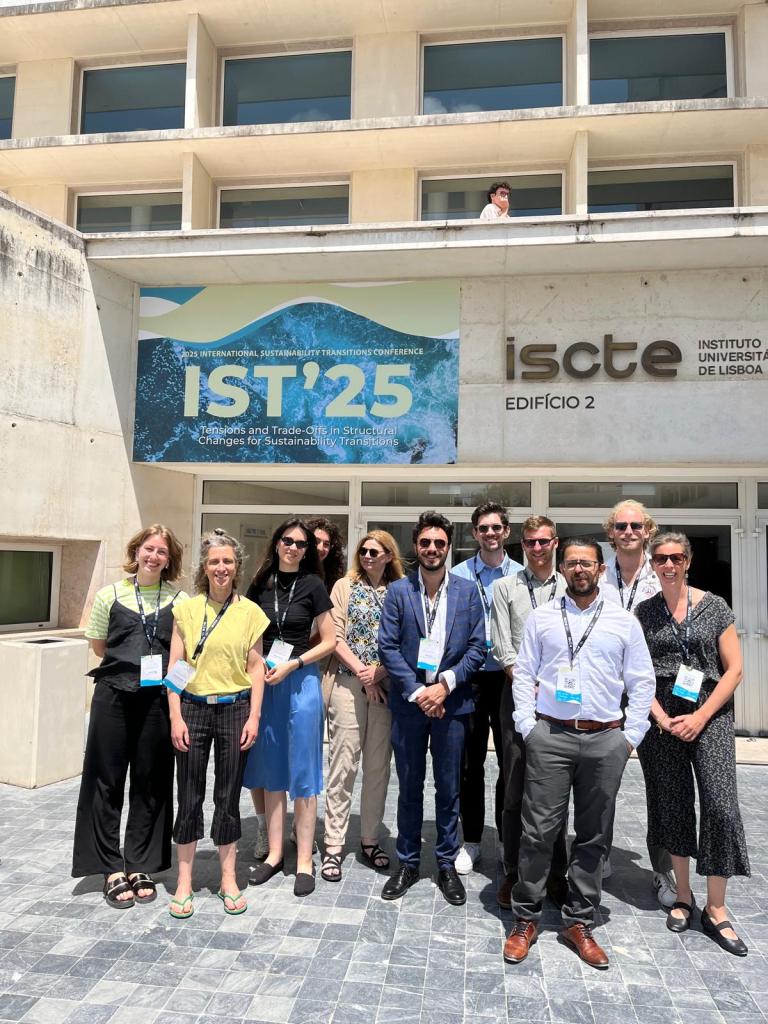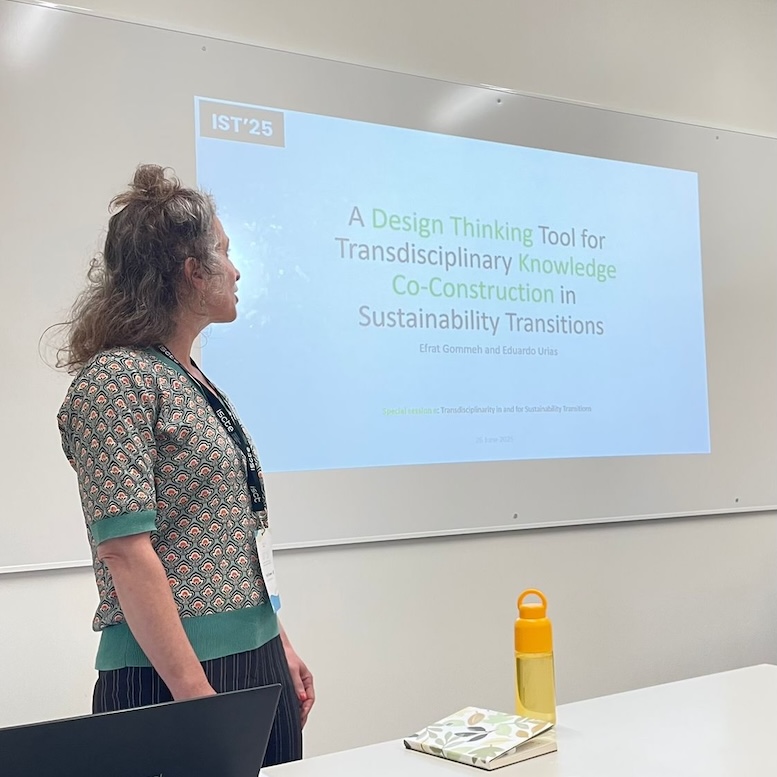
I recently presented a paper at the 16th International Sustainability Transitions (IST) Conference, as part of the special session Transdisciplinarity in and for Sustainability Transitions. The topic: a design thinking tool I’ve been developing to help diverse teams actually collaborate 😉 when tackling sustainability challenges.
What’s the problem? Put people from different disciplines in a room to solve a shared challenge, and something predictable happens: everyone frames the problem through their own lens. The ecologist sees an ecological problem. The economist sees an economic one. The policy person sees a governance gap. Each view is valid, but defined too narrowly, and decisions end up skewed toward whoever’s framing wins out – often the loudest or most senior voice in the room.
The usual instinct is to try to smooth over these differences and find common ground fast. But that’s not actually what good transdisciplinary work needs. Different perspectives are a feature, not a bug, and the friction between them is where the richest, most policy-relevant insights come from. The real challenge isn’t erasing disagreement, it’s building a process that can hold it productively.
So what does the tool actually do? It’s built around a simple but surprisingly powerful move: it asks team members to step outside their expertise entirely, and reframe the challenge from a completely unfamiliar perspective – one nobody at the table has formal knowledge of. Suddenly, no one is the expert. The usual hierarchies flatten, because everyone’s equally out of their depth. From that shared, unfamiliar ground, the team generates fresh insights together. Only then do people bring their domain expertise back in, now grounded in something they built collectively rather than something one discipline imposed on the rest.
Why does this matter for sustainability transitions specifically? Because the challenges are inherently messy, cross-disciplinary, and politically loaded, we can’t just rely on expert consensus-building the old way. We need methods that actively design for inclusion and shared ownership of the problem. It’s not a ‘nice-to-have’, it’s a precondition for making a progress.
It was energising to share this work with a room full of people busy with similar questions and see how a tool rooted in design thinking can offer a genuinely practical way forward.